History of the Trick Shot:
This remarkable trick shot, executed by Wayne Parker, is set up on a Chinese-style 9-foot pool table fitted with snooker-style pockets, which makes the difficulty level significantly higher than on a standard American pool table. Wayne has featured this particular shot on numerous occasions during his professional trick shot exhibitions across South Africa, where it has consistently captivated audiences with its precision and creativity. In this presentation, however, he has given the shot a deeper meaning by adapting it into a Gospel Trick Shot. By doing so, Wayne transforms a moment of skill and entertainment into a powerful word of encouragement for the body of Christ, using the art of billiards as a unique platform to share faith and inspiration.
GTS Name and Meaning:
This shot is titled “Teamwork Makes the Dream Work!” In this Gospel Trick Shot demonstration, Wayne illustrates the power of unity and the importance of recognizing that every person in the Kingdom of God has a vital role to play.
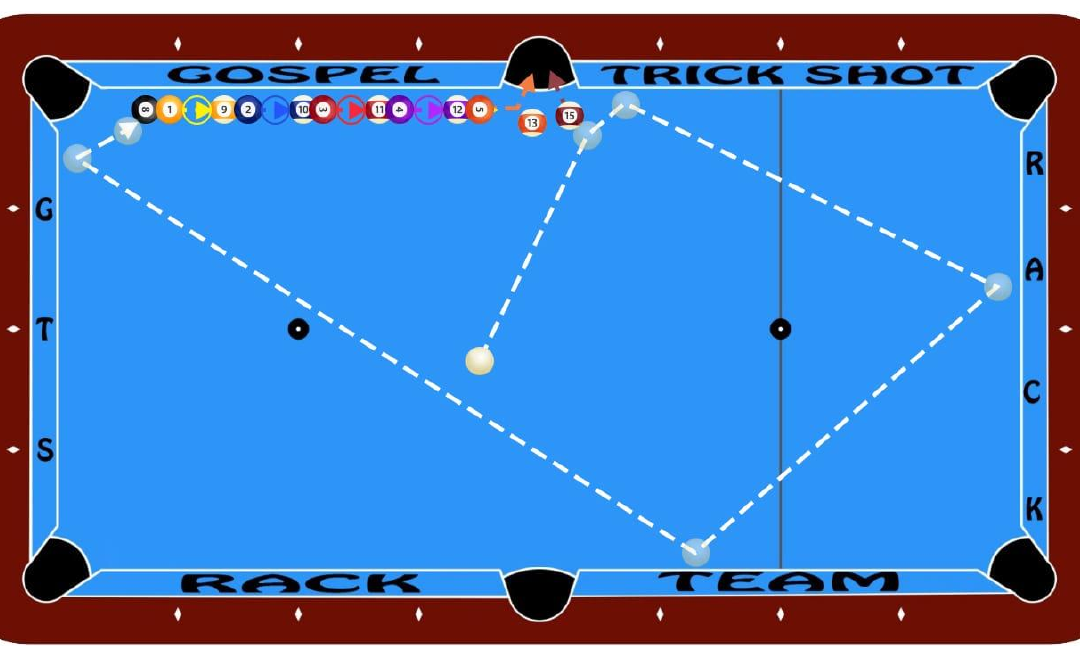
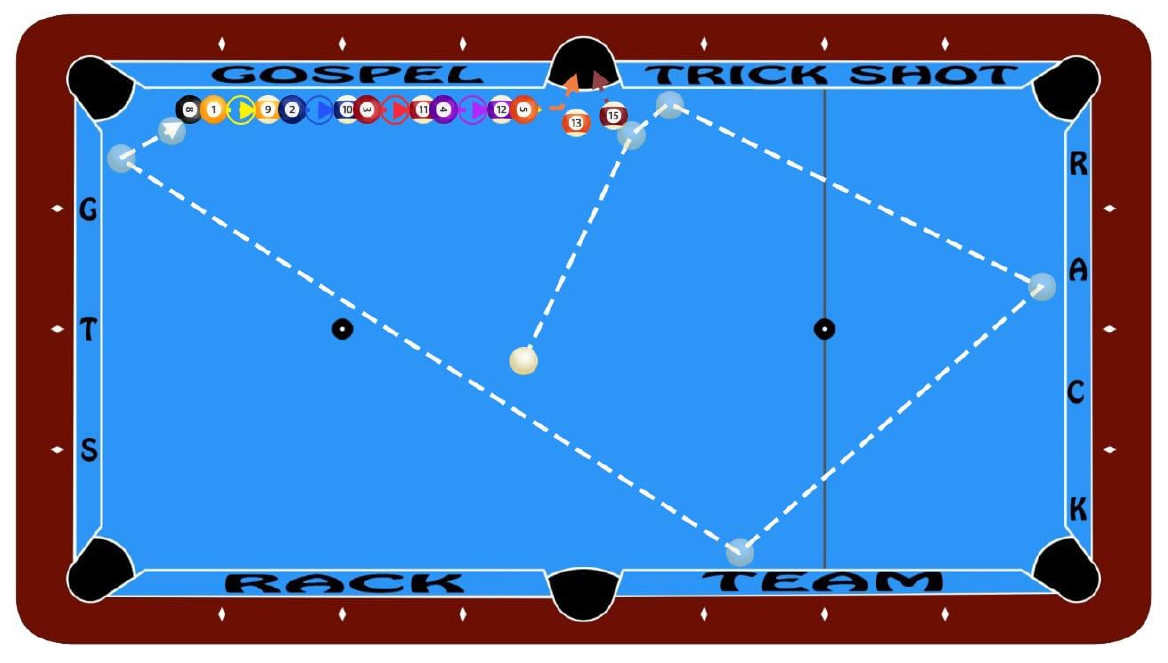
The setup involves five object balls, each carefully balanced on a block of chalk, with a supporting ball positioned alongside each one. The sequence begins when the cue ball is struck to pocket the 15-ball into the side pocket. From there, the cue ball travels around the table, rebounding off four rails before striking the 8-ball. This contact triggers a chain reaction that ultimately sends the 5-ball into the side pocket.
Just as every ball in this shot must work together in perfect sequence for the outcome to be successful, so too does every believer in the Kingdom of God contribute to the greater good. Each person has a unique purpose and a God-given role that is essential, no matter how big or small it may seem. Therefore, never underestimate your value, and never compare your role to someone else’s. God has designed a special plan and purpose for you within His Kingdom, and your contribution matters.
Scripture Reference:
1 Corinthians 3:6–9 (NIV):
“I planted the seed, Apollos watered it, but God has been making it grow. So neither the one who plants nor the one who waters is anything, but only God, who makes things grow. The one who plants and the one who waters have one purpose, and they will each be rewarded according to their own labor. For we are co-workers in God’s service; you are God’s field, God’s building.”
Ball Placement:
- Cue Ball: Place the cue ball on the table in the position shown in the diagram.
Object Balls:
- Balls 1, 2, 3, 4, and 5 are each placed on top of a block of chalk.
- Balls 8, 9, 10, 11, and 12 are placed touching (frozen to) each of the balls above, as shown in the diagram.
- The 13-ball is positioned so the 5-ball will strike it at about half-ball contact.
- The 15-ball is set close to the side pocket, as shown in the diagram.
Objective:
Strike the cue ball firmly with a touch of low-right English (hit slightly below and to the right of center). Aim at the right edge of the 15-ball.
Here’s what will happen:
- The cue ball pockets the 15-ball into the side pocket.
- It then travels around the table, bouncing off four rails as shown in the diagram.
- The cue ball hits the 8-ball, starting a chain reaction that knocks the balls off their chalk blocks.
- Finally, the 5-ball is dislodged, makes contact with the 13-ball, and is pocketed in the side.
Special Notes:
If the cue ball goes around four rails but comes up short—either going straight into the corner pocket or hitting directly into the 8-ball—try hitting the 15-ball a little fuller (thicker) with more low-right English. This will open the angles and send the cue ball into the short rail first before it caroms into the 8-ball.
If the cue ball instead goes too long and hits too far down the last short rail, adjust by hitting the 15-ball a little thinner.
Crowd Reactions:
This is a spectacular shot for the audience, as the domino effect builds suspense until the 5-ball is finally pocketed off the 13-ball. When it drops, the crowd will erupt with applause and cheers.
After the shot, be sure to point out that each pair of balls has come together by color—for example, the yellow solid and stripe, as well as the blue, red, and pink pairs. This creates a powerful visual that highlights the beauty of unity in diversity.